An Operating Model for Modern CS
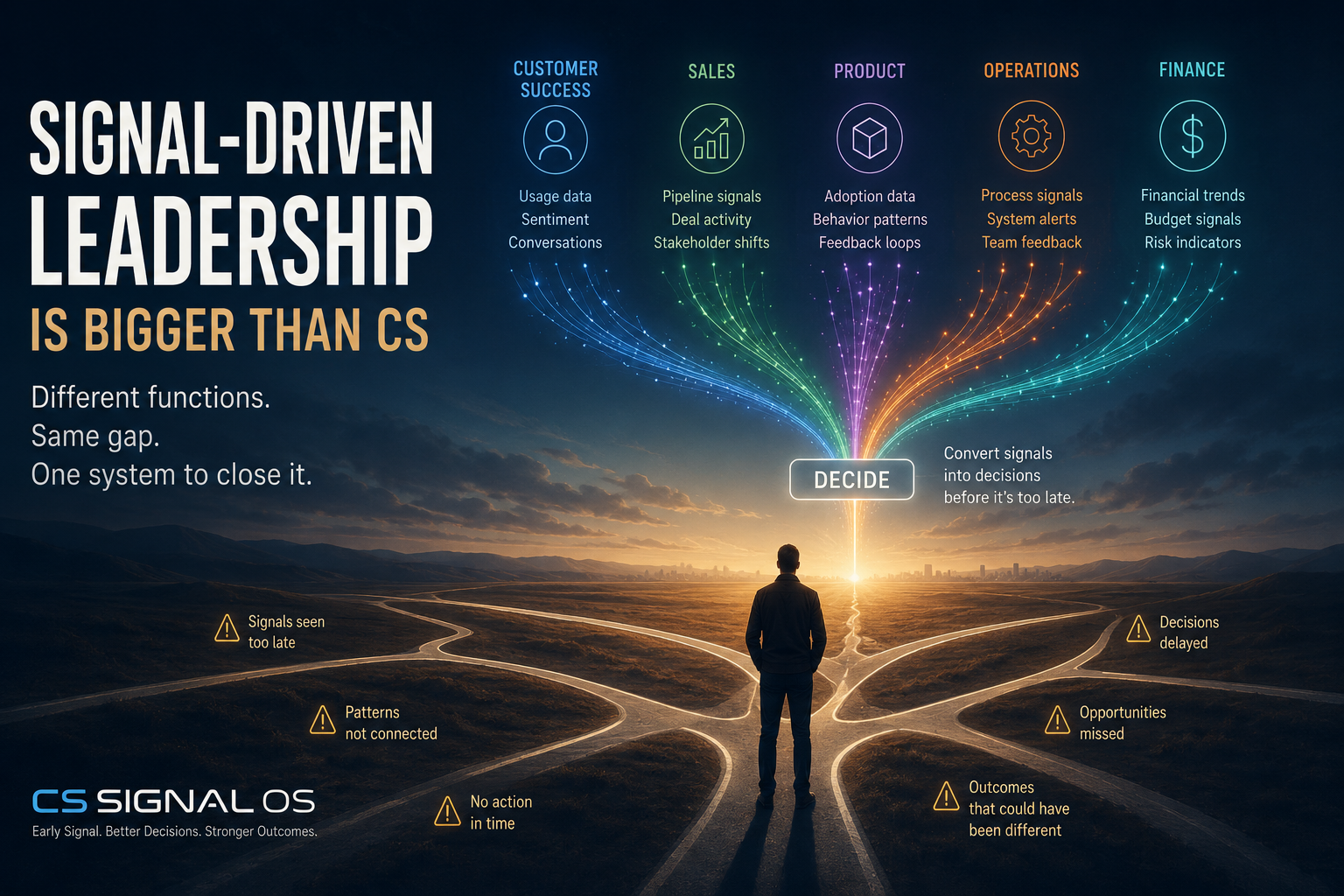
CS Signal OS connects scattered customer signals, detects risk earlier, aggregates context across systems, and converts insight into decisive action before the renewal conversation starts.
The Reality
The Operating Gap
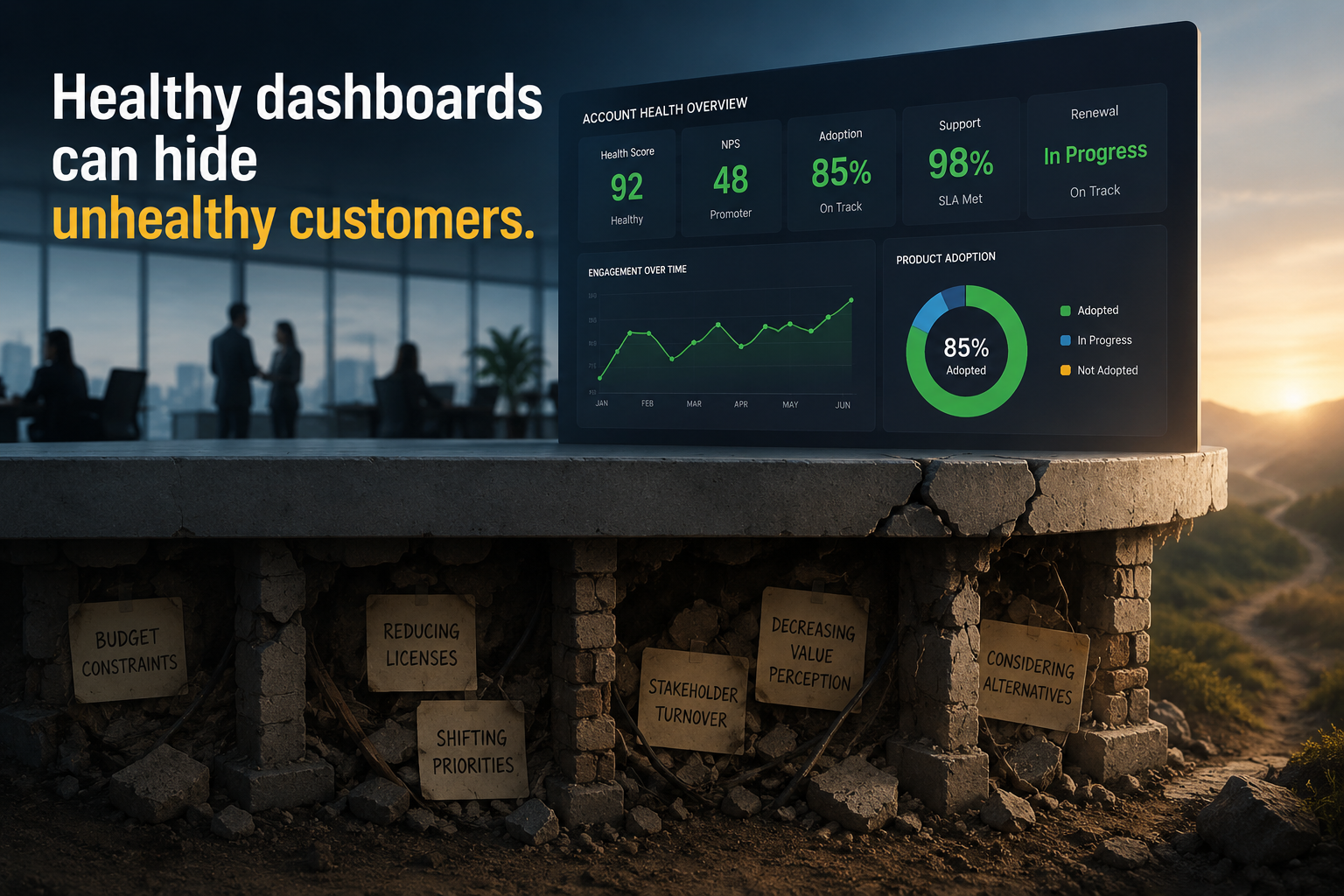
Most CS organizations are structured around outputs: QBR decks, health scores, renewal forecasts. These are backward-looking snapshots of a relationship that has already changed.
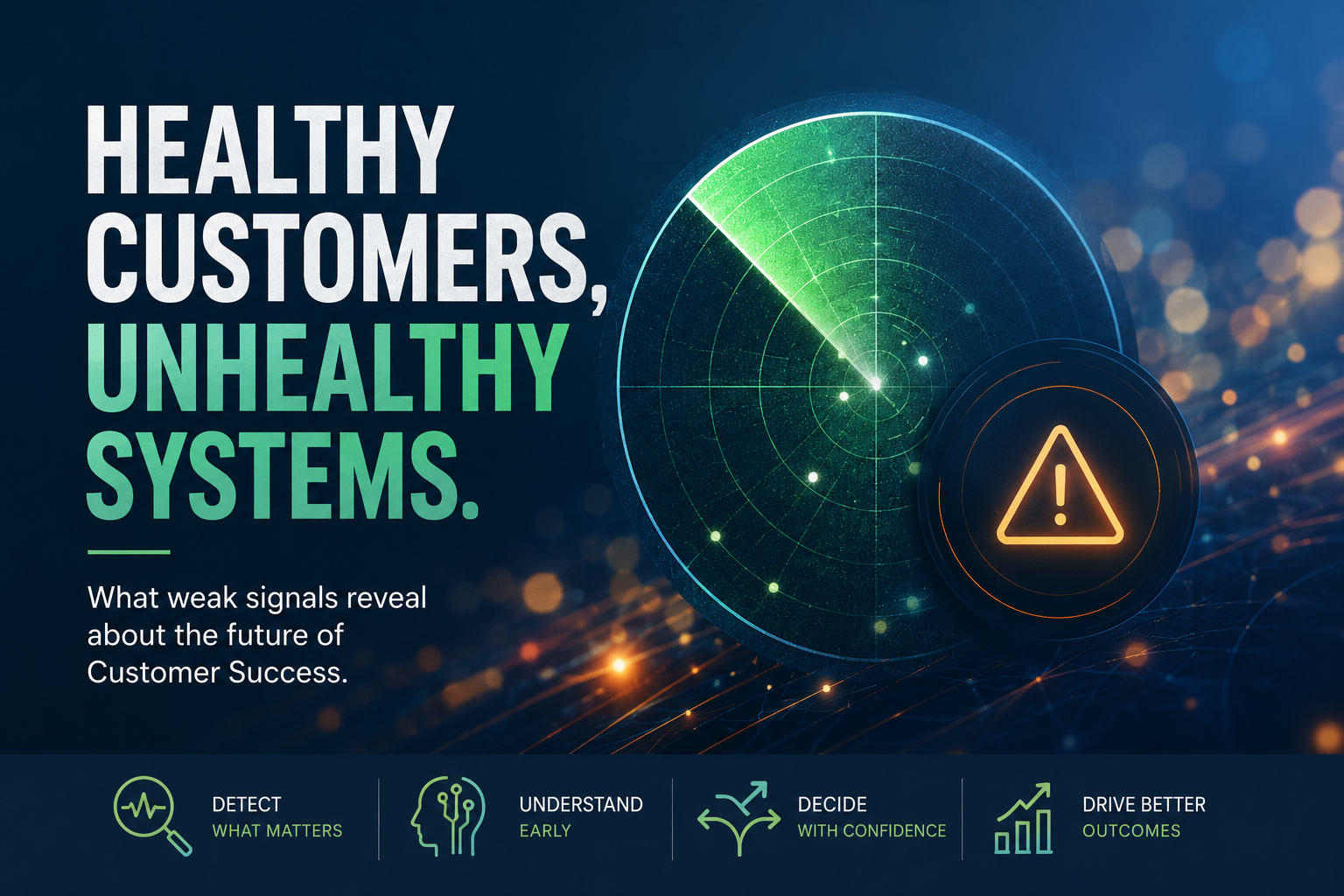
By the time risk surfaces in a CRM field or a red health score, you're already weeks or months behind the actual story. The customer has already formed an opinion. The renewal is already in jeopardy.
"The signal was there. It was in the meeting transcript, in the support ticket, in the email thread. We just weren't reading it in time."
— What enterprise CS leaders say in retrospectCS Signal OS is built around a different operating assumption: that the information needed to retain and grow revenue is already flowing through your organization: in meetings, in support cases, in product data, in executive communications. The job is to connect it, interpret it, and act before the moment passes.
See How the Framework Works →The Operating Model
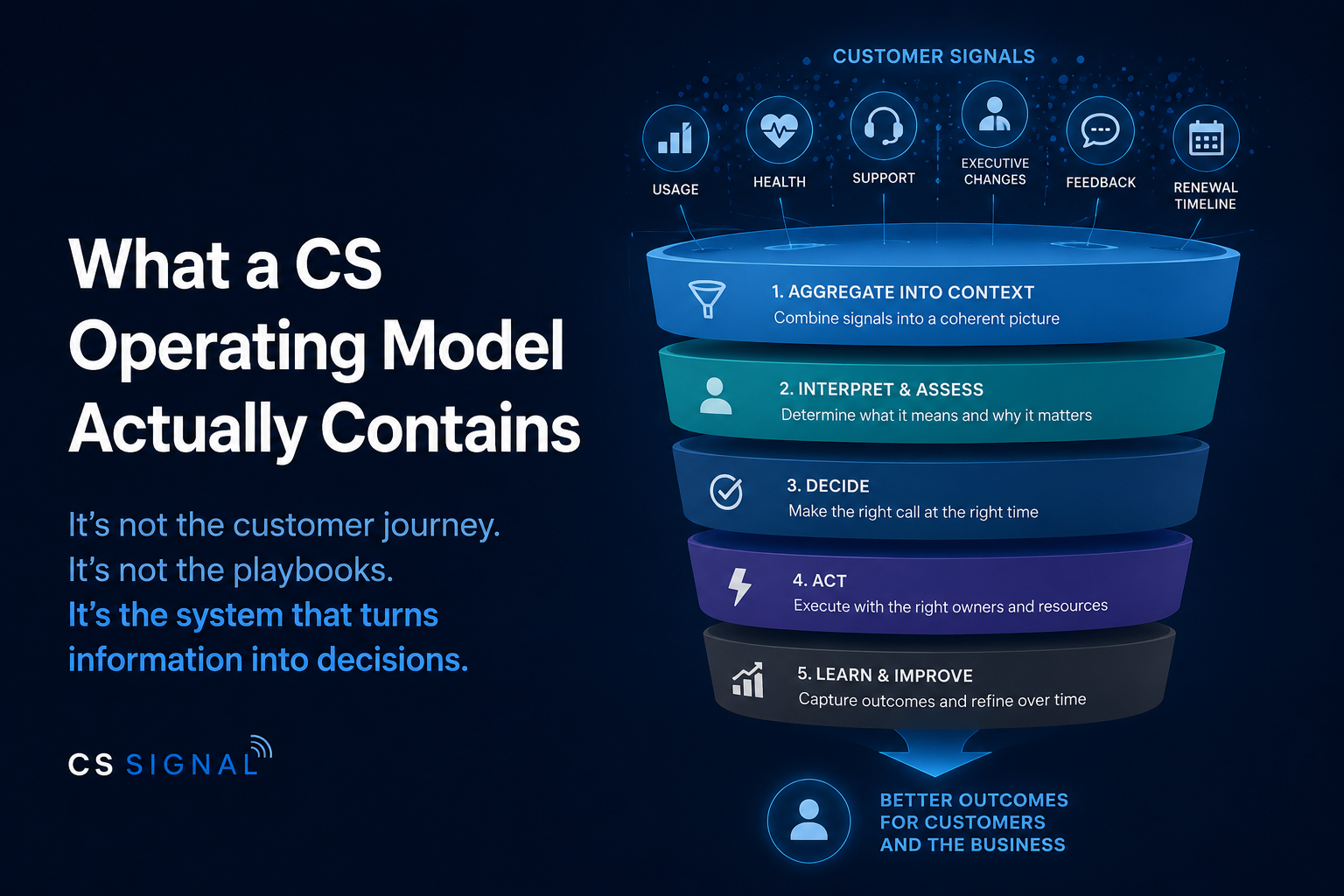
CS Signal OS is not a dashboard, not a CRM add-on, and not an AI feature. It is an operating model that defines how your organization moves from raw customer signals to commercial decisions, with speed, confidence, and consistency.
Every customer interaction generates a signal. Most organizations collect the data but lack a taxonomy for what a signal means, what it indicates, and how it connects to other signals in the account narrative.
CS Signal OS defines a structured signal taxonomy across eight source categories, with pre-defined signal types, severity weighting, and decay rates.
Detection is the layer that transforms raw data into structured signals. Most organizations rely on manual interpretation: a CSM reading a transcript, an ops person running a report. That doesn't scale.
CS Signal OS defines automated detection protocols across each signal category, using AI-assisted pattern recognition and defined trigger conditions that surface signals without waiting for a human to notice them.
Individual signals are noisy. Patterns across signals are meaningful. The aggregation layer is where CS Signal OS generates account narratives: synthesized intelligence drawn from multiple signal sources over time.
This is where AI delivers its most significant leverage in CS: not in automating tasks, but in connecting dots across conversations, systems, and timeframes that no human can track at scale.
The gap between signal and action is often a decision. CS Signal OS defines explicit decision frameworks that convert aggregated intelligence into recommended actions, removing ambiguity from the judgment call.
Decision triggers are pre-defined playbook conditions that fire when signal combinations cross defined thresholds, giving CS teams clarity on when to escalate, engage, or intervene.
Action is where operating models succeed or fail. CS Signal OS defines structured playbooks for each decision trigger: not suggested next steps, but sequenced, accountable action protocols with owners, timelines, and outcome definitions.
At the AI layer, actions include automated brief generation, AI-drafted executive communications, Slack notifications, CRM updates, and orchestrated workflow sequences triggered by confirmed decision states.
Signal Architecture
The architecture is linear by design. Each layer feeds the next. No signal is orphaned. No insight is stranded. The outcome is always commercial.
Applied Use Cases
CS Signal OS isn't a framework for the whiteboard. These are the specific, operational contexts where signal-driven decision-making changes commercial outcomes.
AI-generated account summaries synthesized from 90+ days of cross-signal data. Designed for CRO, CCO, and CEO consumption. Not CSM activity logs. Commercial context, not feature updates.
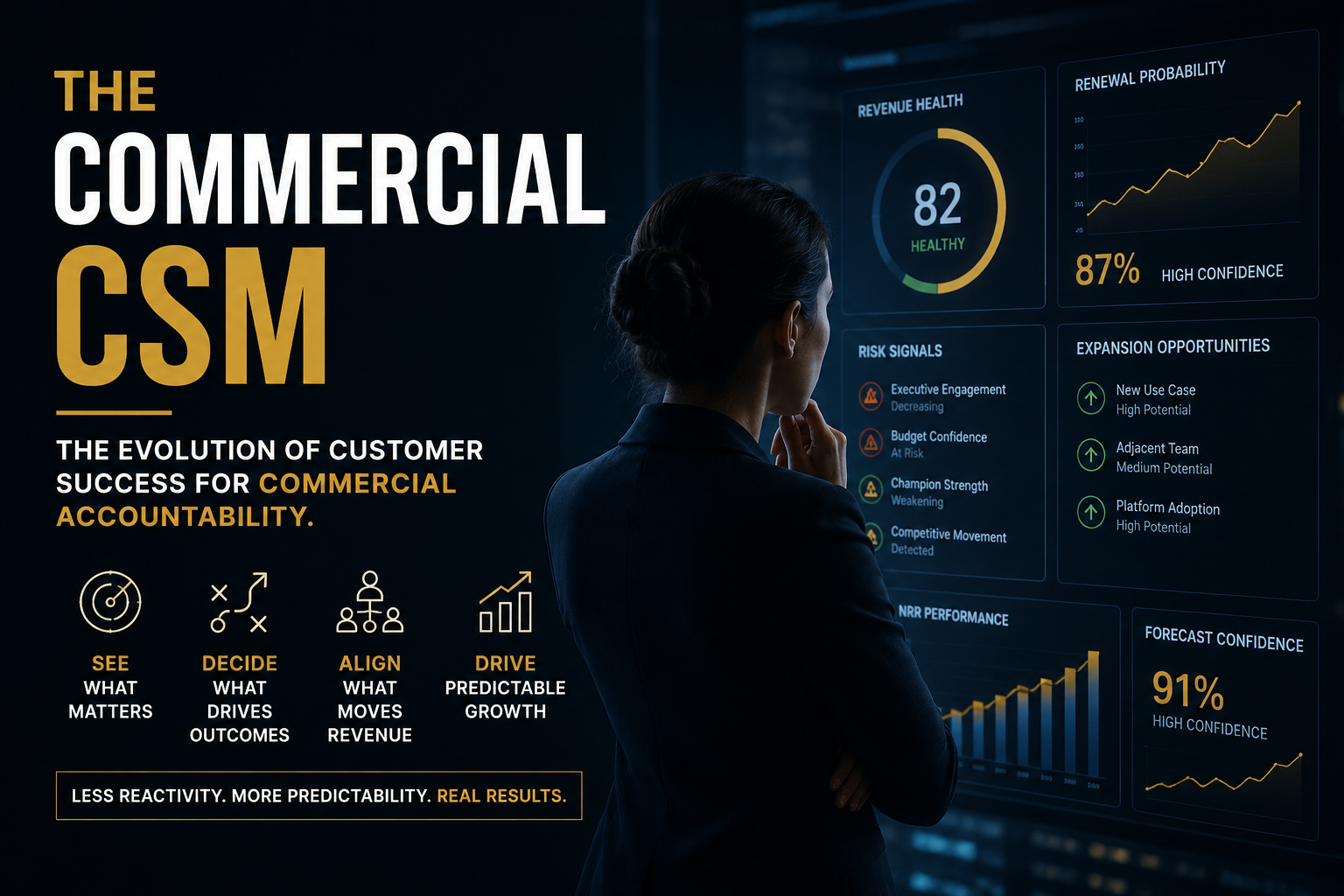
Multi-signal risk scoring that surfaces at-risk accounts 60–90 days before the renewal window. Built on signal correlation, not a single health score field.
Identifies accounts where product depth, engagement quality, and stakeholder sentiment combine to indicate expansion readiness before the AE initiates the conversation.
Structured extraction from meeting transcripts: sentiment trends, commitment tracking, executive presence, and language shift detection across the full account timeline.
Monitors scope creep, delivery friction, and services engagement patterns to surface accounts where professional services margin is at risk before it appears in finance reporting.
Automated weekly portfolio views for CS leadership and revenue leadership. Synthesized from signal data, not manually compiled status updates. Designed for the C-suite attention window.
Before every strategic account conversation, CS Signal OS generates a structured account brief: signal summary, relationship map, risk indicators, historical context, and recommended conversation focus. Your CSM walks in prepared, not catching up.
Insights & Field Notes
About
CS Signal OS came from a specific frustration: spending years watching organizations lose renewals that were winnable, not because they lacked the data, but because the data never connected. Signals existed in every system. No system talked to another.
The framework is built from the inside of enterprise Customer Success: from QBR decks that didn't tell the real story, from renewals that were lost before they were measured, and from the realization that AI could change what's operationally possible for CS teams if it was applied to the right problem.
That problem isn't automation. It's intelligence: connecting signals that were always there, surfacing patterns no human could track at scale, and converting insight into decisions before the renewal window closes.
Start a Conversation
Whether you're a CS leader exploring what this operating model could mean for your team, an executive looking for a clearer picture of portfolio risk, or a peer building AI into your CS practice. Let's talk.