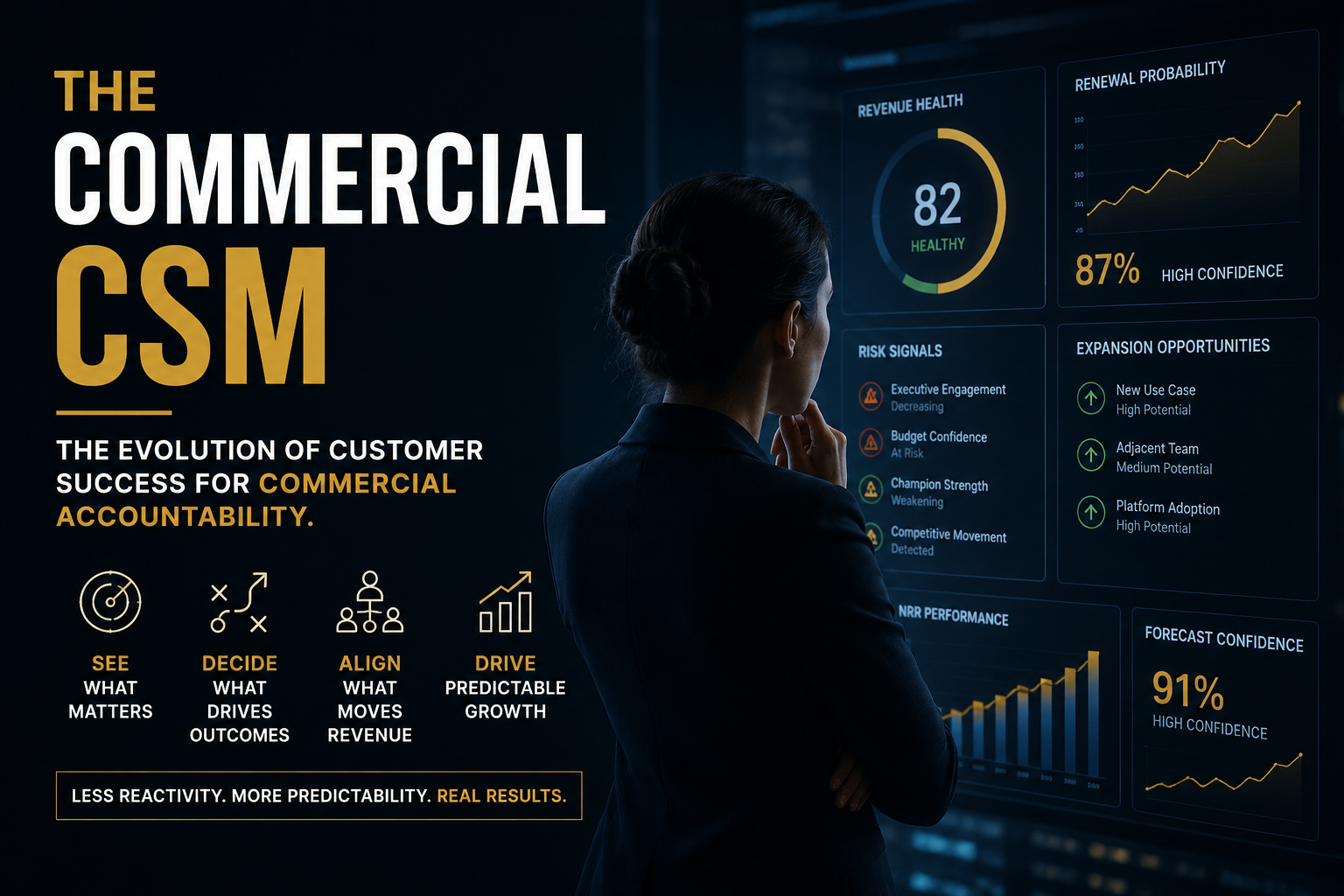
Customer Success has already been commercialized. Leadership just hasn't redesigned the operating model to match. That is the contradiction sitting at the center of modern Customer Success.
For years, the function was built around relationship management. Build trust, drive adoption, be the customer advocate, run executive reviews, maintain engagement, protect the renewal. That model made sense when Customer Success was primarily a post-sale relationship function. But that is no longer the reality. Customer Success organizations are increasingly measured on commercial outcomes: gross retention, net revenue retention, forecast accuracy, expansion influence, churn reduction, revenue predictability. And yet many organizations still operate as if strong relationships are the primary mechanism for delivering those results. They are not. Relationships matter deeply. But a relationship is not an operating model, and that distinction matters more than most leadership teams realize.
The relationship myth
One of the most persistent beliefs in Customer Success leadership is this: strong relationships drive renewals. It sounds reasonable, and in some cases it is partially true. Relationships improve trust, trust improves access, access improves influence. But relationships do not override structural business realities. They do not prevent budget cuts, executive turnover, failed implementations, procurement pressure, competitive displacement, product misalignment, or strategic priority shifts.
Every experienced Customer Success leader has seen it. The account looks healthy. Meetings are happening, executive conversations feel productive, the champion is engaged, the health score is green. Then the renewal falls apart, not because the relationship failed, but because the business changed.
That creates false confidence.
The accountability gap
This is where the traditional model starts to break. While Customer Success is still often designed like a relationship function, leadership expectations have shifted dramatically. Today's CSM is frequently expected to influence retention, expansion, forecasting confidence, executive risk management, and commercial visibility. But what authority do they actually have? Often, very little.
Sales can oversell. Professional Services can mis-scope. Product can deprioritize critical customer needs. Support can mishandle escalations. Finance can restrict commercial flexibility. Leadership can shift strategy. And when the customer reduces spend or fails to renew, Customer Success absorbs the impact. That is not accountability. That is structural misalignment.
A Customer Success leader should be able to answer a simple question: if Customer Success owns the outcome, what decisions can Customer Success actually control? If the answer is unclear, the operating model is broken.
The hero dependency trap
Many organizations believe their Customer Success model works because strong CSMs keep producing outcomes. That belief can be dangerously misleading. High-performing CSMs often compensate for broken systems through intuition, relationship strength, internal influence, tribal knowledge, and sheer effort. Leadership sees retention, customer satisfaction, and renewals, and concludes the model is working. What they may actually be seeing is heroics.
That is the difference between a strong individual contributor and a scalable operating system.
What actually changes
A Commercial CSM is not simply a better CSM. That framing misses the point entirely. A really good CSM can thrive inside the existing model. A Commercial CSM represents something different: a role designed for commercial decision-making, not relationship activity management.
That changes the posture of the work. Traditional Customer Success often asks how the customer is feeling, how engaged they are, what support they need. Commercial Customer Success asks what changed in this business, what signals suggest risk or opportunity, and what commercial decision needs to happen next.
That is a fundamentally different operating model, because activity is no longer mistaken for progress. More meetings do not automatically create predictability. More executive touchpoints do not automatically reduce risk. A Commercial CSM is not measured by how active the account feels. They are measured by how effectively the organization detects, interprets, and acts on commercial reality.
What CEOs actually care about
This conversation becomes irrelevant if it stays philosophical. Executives care about business outcomes, and a Commercial Customer Success model should measurably outperform the traditional model in five specific areas.
Earlier risk detection. Traditional risk identification often happens late: renewal conversations become difficult, health scores shift, escalations become obvious, executive dissatisfaction becomes explicit. Commercial Customer Success identifies earlier signals: executive disengagement, budget language shifts, procurement timing changes, weakening champions, adoption concentration risk, project slippage, competitive movement. The executive translation is straightforward: we lose fewer customers we should have seen coming.
Better forecast accuracy. Traditional renewal forecasting often relies on rep confidence, relationship optimism, subjective sentiment, and health score color, which creates volatility. Commercial Customer Success relies on structured signal interpretation, explicit probability thinking, documented evidence, and confidence movement over time. Retention forecasting becomes materially more reliable.
Stronger net revenue retention. Commercial thinking does not mean turning CSMs into salespeople. It means identifying growth and contraction signals earlier, whether that is organizational expansion, executive initiative shifts, adjacent use case visibility, underutilized capability, or competitive displacement windows. The outcome is better expansion timing, stronger expansion quality, and healthier NRR.
Lower cost-to-retain. Traditional Customer Success often relies on expensive heroics: executive rescue meetings, reactive escalations, cross-functional firefighting, late-stage retention motions, unnecessary concessions. Commercial maturity enables earlier intervention, which means fewer save motions, less leadership thrash, and lower organizational drag.
Reduced hero dependency. Traditional Customer Success often depends on exceptional intuition, relationship craftsmanship, hidden expertise, and tribal knowledge. That creates fragility. Commercial maturity operationalizes signal frameworks, escalation pathways, decision models, intervention logic, and repeatable operating discipline. The business becomes less dependent on individual heroics.
This is not "CS becomes Sales"
That is the most common criticism, and it is understandable. Bad implementations absolutely exist. Some organizations have already damaged Customer Success by forcing artificial quota pressure into roles designed for trust and long-term customer partnership. That is not what this is.
Commercial Customer Success means accountable business stewardship, not aggressive selling. Relationships still matter deeply. But the relationship is no longer the operating system. It becomes a mechanism of influence inside a more disciplined commercial model.
The bigger operating model
The Commercial CSM is not the full answer. It is one expression of a larger shift. The real operating challenge is this: how does Customer Success consistently detect weak signals, aggregate fragmented intelligence, accelerate decision-making, and trigger the right interventions before outcomes deteriorate?
That requires more than talented people. It requires infrastructure, frameworks, operating discipline, signal visibility, and decision systems. This is where Customer Success must evolve from reactive relationship management toward commercial operating intelligence.
Final thought
Customer Success leaders should ask themselves a difficult question: if you replaced your strongest CSM with an average but disciplined operator, would the system still work? If the answer is no, the problem may not be talent. It may be design.
Customer Success has already been commercialized. Leadership just hasn't redesigned the operating model to match. The Commercial CSM is not simply a new role label. It is the human operating model that emerges when Customer Success is finally built for the outcomes it is already expected to own.