Every executive asks some version of the same question: "How are renewals looking?"
It's a fair question. Renewals matter. Retention matters. Expansion matters. But after years in Customer Success, I've come to believe it's also one of the most dangerous questions leadership can fixate on. Because by the time a renewal is visibly at risk, the real story has usually already played out. The renewal didn't create the risk. It revealed it.
This wasn't shaped by a single bad experience. It was pattern recognition, the kind that keeps repeating until you stop calling it bad luck.
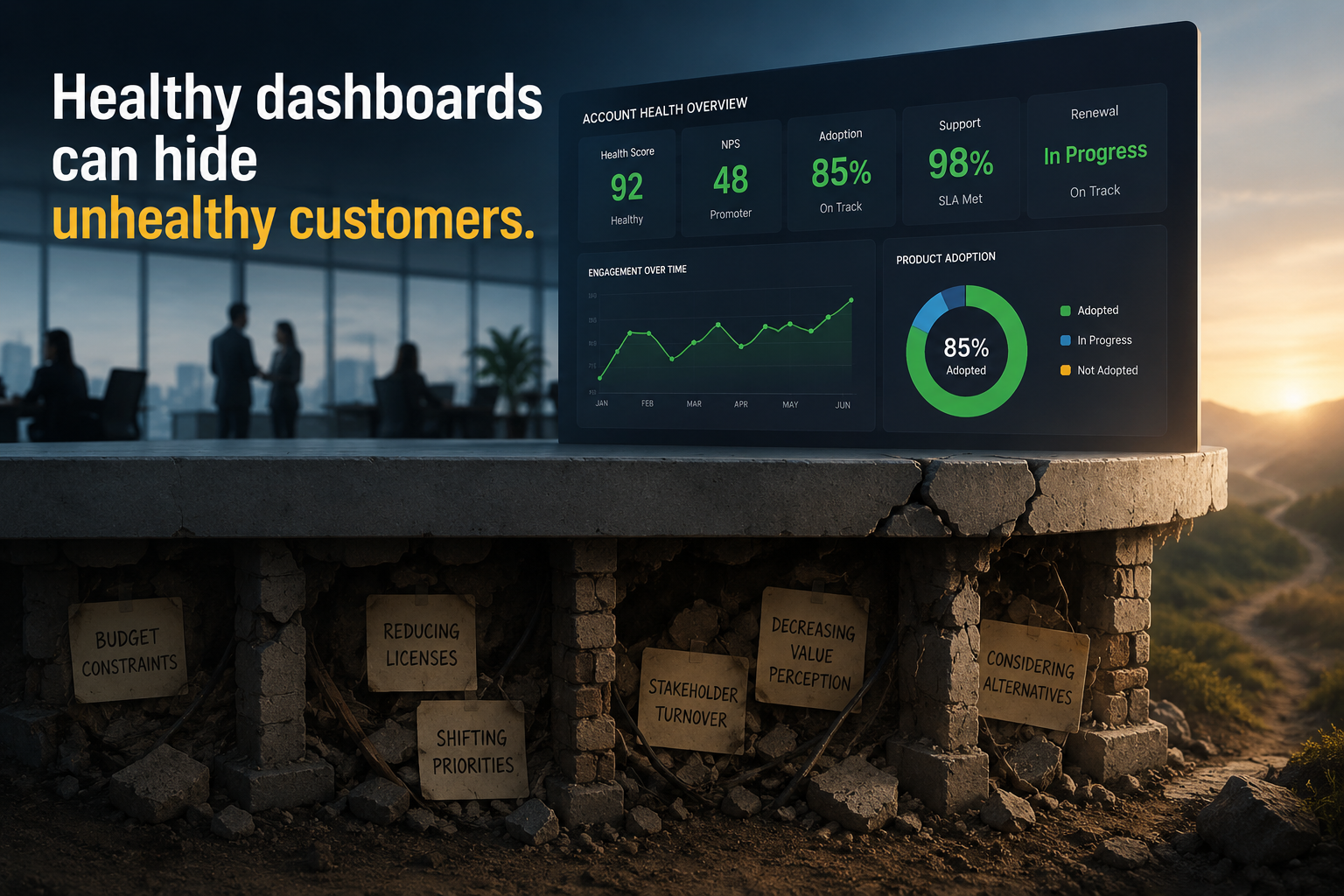
Healthy Dashboards Can Hide Unhealthy Customers
I've managed accounts where everything looked solid. Monthly meetings were happening. Customer activity was steady. They were seeing real ROI. Support tickets were minimal, and when they came in, they were resolved well within SLA. Renewal conversations started without any friction.
By every traditional metric, this should have been a clean renewal.
Then somewhere in the middle of what felt like a routine conversation: "Oh, by the way, we've decided we won't be renewing."
That moment hits hard. Not just because of the commercial impact, but because your first thought is: what the heck happened? Then comes the exercise every experienced CS leader knows too well. Going backward through emails, meeting notes, transcripts, looking for the signals you missed. Because deep down, you already know the truth. The signals were probably there.
Most organizations track the familiar indicators: meeting cadence, activity volume, support ticket health, adoption metrics, success plan completion, NPS, renewal progression, executive dashboards. None of that is inherently wrong. The problem is when those metrics create false confidence, because traditional health indicators measure operational visibility, not strategic risk.
A customer can show up to every meeting and already be reconsidering your place in their future. A success plan can exist in your CRM with almost no connection to what the customer actually cares about right now. Support can look clean because the customer quietly stopped pushing for expansion. Renewal conversations can start normally because nobody wants an awkward moment until the decision is already made.
The Signals Are Almost Never Absent
One of the biggest misconceptions in Customer Success is that churn feels sudden. It rarely does.
Signals tend to show up gradually, sometimes weeks before the conversation, sometimes months. And they're almost never dramatic. It usually looks more like a slow progression.
Month one: "Our budget is really tight this year." Month two: "Can we take a look at how many licenses we're actually using?" Month three: "I think we're going to need to reduce licenses for the upcoming year."
None of those statements guarantee churn on their own. That's not the point. The point is the progression. A license reduction this year should immediately raise concern about next year if the organization can't reverse that momentum.
The issue was never signal absence. It's signal interpretation. Signals are everywhere: shifts in customer language, slower response urgency, flatter meeting energy, fewer strategic conversations, an executive sponsor who stops showing up, license optimization discussions, delayed initiatives, internal reorgs, stalled adoption. Most organizations don't connect these moments as a pattern. They treat them as isolated events.
Customer Success Is Drowning in Information, Not Starving for It
This is where I think a lot of organizations get the diagnosis wrong. The problem isn't a lack of data. It's fragmentation, compliance theater, and operational disconnect.
We document everything: emails, meeting notes, call transcripts, CRM updates, success plans, support history, Slack messages, product telemetry. And somehow we still miss what matters most.
The reason is that too often, everyone is just going through the motions. The success plan exists because leadership wants internal reporting, not because it reflects actual customer momentum. Notes get logged because the process says they should, not because anyone is synthesizing them into real decisions. Meanwhile, the broader account team is operating across different systems with different habits, different interpretations, and different workflows.
Then we schedule recurring internal meetings to share notes that already live somewhere else. The classic meeting that should have been an email, or better yet, automated signal intelligence. This isn't a people problem alone, and it isn't a technology problem alone. It's an operating model problem.
We May Be Rewarding the Wrong Behaviors
This is where things get uncomfortable. Organizations often incentivize the exact behaviors that create blind spots. CS teams get rewarded for conference attendance, health scores, NPS, account activity, cadence adherence, and retention outcomes. None of that is inherently bad, but it can breed dangerous complacency.
You can finish a year at 100% retention and have seen warning signs the entire time. When everything is green, smaller problems become easy to dismiss. Teams settle into routine. Patterns normalize. People stop questioning assumptions. That's when real risk gets missed, because the dashboard says healthy even as the underlying foundation quietly deteriorates.
If your team is getting surprised by renewal risk, it may be because the metrics they were tracking reflected a solid relationship on the surface, without capturing what was happening underneath.
Where AI Actually Fits
AI is not replacing Customer Success professionals, and it shouldn't replace the human parts of the relationship. As both a practitioner and a customer, I don't want automated AI pretending to be authentic relationship engagement. Customers know the difference. Trust matters. Human judgment matters.
But AI has a significant role to play here, and it isn't in replacing CSMs. It's in augmenting them. AI should be doing the work no human should be expected to do manually: correlating fragmented signals across systems, detecting patterns that get buried in volume, summarizing account risk, surfacing progression trends, recommending next actions, and cutting internal coordination overhead. That's where AI becomes genuinely transformational. Not by replacing relationships, but by accelerating intelligence.
Why Operating Models Matter More Than Tools
If I were advising a CS organization tomorrow, I wouldn't start by recommending more tools. That's usually the wrong first move.
I'd start by understanding their current people, processes, and technology. What signals are already being captured? Where do they live? Who owns interpretation? What decisions actually get made from those insights? Where does fragmentation exist? Because most organizations already have most of what they need. What they're missing is orchestration.
Customer Success doesn't need more disconnected dashboards. It needs a signal-driven operating model. That's the thinking behind CS Signal OS, not as a product but as an operating philosophy. A belief that modern Customer Success should move beyond reactive relationship management toward a model built around a clear sequence: Signal, Detection, Aggregation, Decision, Action.
Because if the signals are already present, the real competitive advantage isn't collecting more information. It's interpreting what already exists faster and more intelligently.
Final Thought
Renewals matter. But they are lagging indicators. They tell you what happened, not what's happening, and certainly not what was happening months before the conversation started.
The next generation of Customer Success organizations won't outperform because they got better at renewal management. They'll outperform because they got better at recognizing risk long before the renewal conversation ever begins.