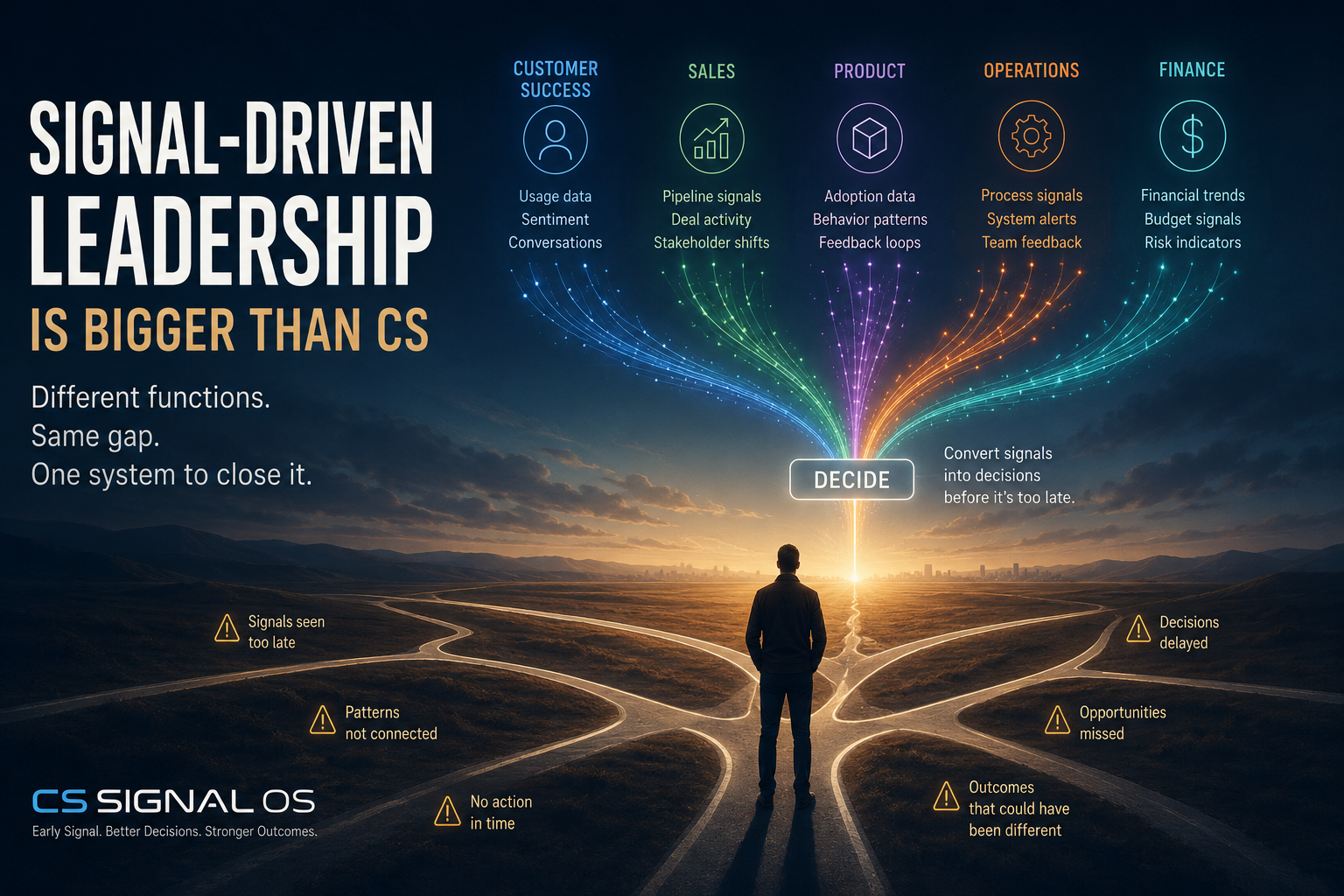
I built CS Signal OS to solve one problem. Customer Success teams generate signals constantly: usage data, executive sentiment, support patterns, meeting transcripts. What they don't have is a system that turns those signals into a consistent decision before the moment to act has passed. I spent the better part of two years building that system inside my own portfolio, then generalizing it into something a team could run without depending on me. That work is still the foundation of everything I do, and it is still the reason CS Signal OS exists.
But somewhere in the process of building it, and in conversations with people running teams well outside Customer Success, I started noticing something I did not expect. The problem I thought was specific to CS was not specific to CS at all. It was the same gap wearing a different uniform. A sales leader losing a deal that had been telegraphing trouble for three weeks. A product leader watching adoption plateau while the roadmap kept moving forward as if nothing had changed. An operations leader discovering a process had been quietly breaking down for a quarter because nobody had connected the individual complaints into a pattern. Different function, different vocabulary, same structural failure: the organization saw something early and could not convert it into action in time for the timing to matter.
The Question Every Leader Is Actually Answering
Every leadership job, regardless of function, comes down to the same underlying question, whether or not the person doing the job has ever framed it that way. Information is arriving constantly, from meetings and dashboards and offhand comments and system logs. Most of it does not matter. Some of it matters enormously, and the difference between the two is rarely obvious in the moment it shows up. The leaders who separate themselves are not the ones who see more. Plenty of leaders have access to the same information as everyone around them. What separates them is how consistently they convert what they see into a decision before the rest of the organization agrees there was even a decision to make.
That is a much narrower skill than "good judgment," and it is more teachable than most leadership advice implies. It has a shape. Something has to surface the raw signal. Something has to recognize it as meaningful rather than noise. Something has to combine it with everything else that is true about the situation. Something has to translate that combination into a specific action. And something has to make sure the action actually happens instead of dissolving into a task nobody owns. Strip away the industry-specific language and that sequence is identical whether you are running a customer portfolio, a sales pipeline, a product roadmap, or a finance function.
Why This Got Proven in Customer Success First
I did not set out to discover a universal leadership principle. I set out to fix an aggregation problem in my own CS portfolio, because I was tired of watching accounts drift into risk that had been visible for weeks before anyone acted on it. CS turned out to be a useful place to prove this out for a specific reason: the consequences show up fast, and they arrive with a dollar amount already attached. A renewal is either signed or it is not. An account either expands or it does not. There is very little room for a CS leader to convince themselves the system worked when the outcome says otherwise.
That immediacy is what made the gap impossible to ignore. In a lot of other functions, the same failure exists but takes longer to surface, or gets absorbed into a dozen other explanations before anyone traces it back to the actual cause. A stalled deal gets written off as a bad fit prospect. A plateaued feature gets attributed to market saturation. A quietly degrading process gets treated as a staffing issue. CS does not have that luxury, which is exactly why it was the right place to build and pressure test a real system rather than a theory.
The Same Gap, Wearing Different Clothes
Once you know what the pattern looks like, it shows up everywhere. In sales, it looks like a deal that has been quietly slipping for a month. The champion's replies get shorter. The internal advocate stops looping in their VP. A competitor gets mentioned once on a call and never comes up again in any note anyone writes. Every one of those is a signal. None of them individually triggers a forecast conversation, and by the time the deal shows up as at risk in the pipeline review, the moment to intervene has usually already passed.
In product, it looks like usage data that plateaus quietly while the roadmap keeps moving forward as though the last release solved the problem it was meant to solve. Support tickets start clustering around the same workflow. Power users stop logging feature requests, not because they are satisfied but because they have stopped expecting anything to change. The dashboard looks stable. The organization treats stable as healthy. Nobody connects the plateau, the ticket cluster, and the silence into the same story until a churn number forces the conversation.
In operations, it looks like a handoff that has been slipping by a few hours at a time for months, never enough on any single day to trigger an escalation, until the cumulative delay shows up as a customer complaint that gets treated as an isolated incident instead of the tenth data point in a pattern that has been building the entire time.
In finance, it looks like a forecast variance that keeps landing just inside the range everyone has agreed is acceptable, quarter after quarter, until the pattern of landing just inside acceptable turns out to be its own signal that nobody was tracking, because no single quarter ever crossed the threshold that would have forced a real conversation.
And in people leadership, it looks like the shape of the average 1:1. A leader who opens with "what did you work on this week" is asking their direct report to spend the first ten minutes of a scarce hour rebuilding a status picture the leader should already have had. I made this point in an earlier post: the signal-driven version of that meeting starts from the other direction. The leader already knows what got done, because the information was aggregated before the meeting started, and the conversation opens with here's what you've done and here's what you should be thinking about next, not a request to recap the week. The information exists. It just never gets aggregated into anything a leader can act on before the meeting begins, which is a more expensive habit than it looks like from the inside.
What the Leaders Who See It Actually Do
The leaders who consistently catch these patterns early are not smarter than everyone around them, and they are not working with meaningfully better information. What they have built, usually without naming it this explicitly, is a version of the same operating system: a defined set of things worth watching, a habit or a process for noticing when those things shift, a way of combining shifts into a real picture instead of a list of disconnected facts, a clear sense of what specific action a given picture should trigger, and enough discipline to make sure that action actually happens rather than becoming a note nobody follows up on.
What makes this hard to copy is that it usually lives entirely inside one person's head. It is instinct, refined over years, and it leaves the organization the moment that person takes a different job. That is the real cost of signal-blind leadership, and it has nothing to do with effort or talent. The organization is only ever as good at converting signal into decision as its most experienced person, on their best day, with enough bandwidth to personally apply that instinct to every situation that needs it. That ceiling is low, and it gets lower the moment the organization scales past what one exceptional person can hold in their head.
This Is Not a Bigger CS Framework
CS Signal OS is a five layer system: signal sources, detection, aggregation, decision triggers, and orchestrated action. I built it in Customer Success language because that is where my credibility lives and where I could test it against real accounts and real consequences. But nothing about the underlying logic is CS specific. Swap "renewal risk" for "deal risk" or "adoption plateau" or "attrition risk" and the five layers still describe exactly the same problem and exactly the same fix.
I want to be precise about what I am claiming here, because it would be easy to overstate it. I am not arguing that every function should run CS software, or that a CS methodology should be forced onto sales or product or finance. I am arguing something narrower, and I think more durable: that the underlying architecture, information in, decision out, consistently and fast enough to matter, is a leadership problem before it is a functional one. CS is where I proved it works. It is not the ceiling of where it applies.
What Actually Changes If You Take This Seriously
If signal to decision is the real operating system underneath good leadership, the practical implication is not "buy a tool." It is a shift in what a leader treats as their actual job. Instead of managing people and reviewing outcomes after they happen, the work becomes designing the environment that determines whether the right information reaches the right person in time to act on it. That is a different discipline than most leaders were trained in, and it does not show up cleanly on most leadership competency models, because it sits closer to systems design than it does to management in the traditional sense.
The organizations that pull ahead over the next decade will not be the ones with the most data, or even the most AI. Nearly everyone will have access to both within a few years, and access alone does not create an advantage once everyone has it. The advantage will belong to the leaders and the organizations that have built a real signal to decision operating system, one that does not depend on any single person's instincts to function, and that gets faster and more consistent the longer it runs.
Where This Goes From Here
I built CS Signal OS to fix a problem I was living inside of every day. I am not ready to claim I have proven the universal version of this argument the way I have proven the CS version, with real accounts and real renewal outcomes behind it. What I can say is that every conversation I have had outside of Customer Success, with people running sales teams, product organizations, and operations functions, has described the exact same shape of problem in different words. That is not proof. It is a strong enough pattern that I think it is worth saying out loud before I have the full case built.
Customer Success is where I started, because it is where my experience and my credibility actually are. It will not be the only place this argument gets tested.